Step C — Evidence list generation
Evidence List Generation produces a structured list of evidence requests and acquisition guidance so teams know what support to collect for each control and test step.
At a glance
Generate evidence requests that align to the controls and test procedures already defined in planning.
Reviewed outputs from RCM Generation and Test Step Generation.
Evidence identifiers, names, descriptions, and acquisition instructions.
Clear evidence requirements reduce rework and improve the quality of testing support collected.
Purpose of Evidence List Generation
Step C is where AssureGrid turns the planning logic from earlier steps into a usable evidence request list. The intent is to help teams collect the right support the first time rather than waiting until execution to discover that required documents, reports, or records were not requested clearly enough.
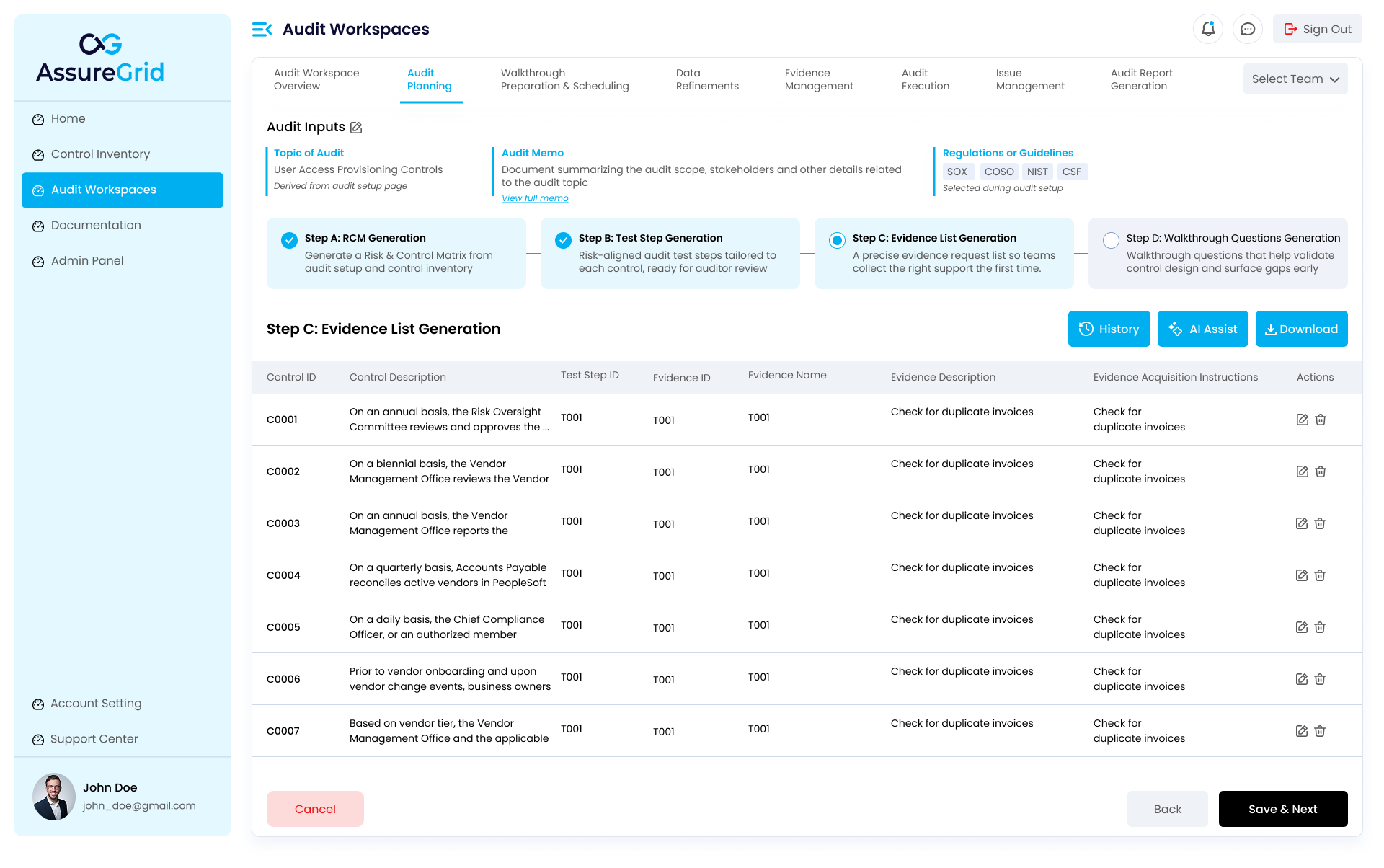
What the generated evidence list contains
The evidence list is displayed in a structured table and typically includes the control ID, control description, related test step ID, evidence ID, evidence name, evidence description, and evidence acquisition instructions. This provides a clear bridge between the testing procedure and the support expected to substantiate it.
-
Evidence ID helps uniquely reference a requested support item.
-
Evidence name provides a concise label for the document or report requested.
-
Evidence description explains what is expected or why it is relevant.
-
Acquisition instructions guide the team on what to request, confirm, or obtain from process owners.
How users should review Step C
-
Check that each evidence item is clearly tied to a control and test step.
-
Confirm that the evidence description is understandable to someone fulfilling the request.
-
Review acquisition instructions for practicality and specificity.
-
Identify missing requests where a test step would otherwise be difficult to execute or support.
Using History, AI Assist, and Download
The interface provides the same supporting actions visible across later planning stages. History can help users compare prior outputs, AI Assist can support wording improvements or clarity, and Download can be used when the evidence list needs to be shared or reviewed outside the platform.
Good evidence request: The strongest evidence lists are precise enough for request management, but not so narrow that they exclude valid support that would still satisfy the test objective.
What to validate before moving on
-
Every major test procedure has an associated evidence request.
-
Descriptions are clear enough for control owners or coordinators to understand what is needed.
-
Acquisition instructions are actionable and not dependent on undocumented assumptions.
-
The evidence list is practical for execution and does not create unnecessary request volume.
Once Step C has been reviewed and saved, the planning flow can proceed to Walkthrough Questionnaire Generation.